Hide caption Janice, 56, fears for her special-needs child, Bryce, 31. Hide caption Nomophobia: Fear of being separated from one's cellphone. Hide caption
Bill, 26, has trypophobia, a fear of holes or small clusters of holes.
Hide caption Kate, 59, fears being in a nursing home or hospital, and having a TV going all day. Hide caption Marcy, 60, fears not having her camera to record a big moment. Hide caption Anonymous fears working so hard that they forget to live. Hide caption Michelle, 22, fears making the wrong decisions in life. Hide caption Steve, 54, fears having his voice changed, altered or lost. Hide caption Anna, 19, fears getting her back broken and having to be in a wheelchair. Hide caption Catherine, 26, fears not knowing how rheumatoid arthritis will affect her joints. Hide caption Nic, 29, fears the idea of being wrongfully imprisoned.
A few years ago, Julie Elman, an associate professor at Ohio University, was stuck in a creative rut. As a design educator and illustrator, most of her work was done on the computer. She wanted to begin a tangible project — remember those? — but didn't really know where to start.
Then she realized there was one emotion she was strangely preoccupied with: fear. "I thought fears would go away as we get older," she remembers thinking. "I'm in my 50s. Why do I still have fears?"
And that is how The Fear Project was born.
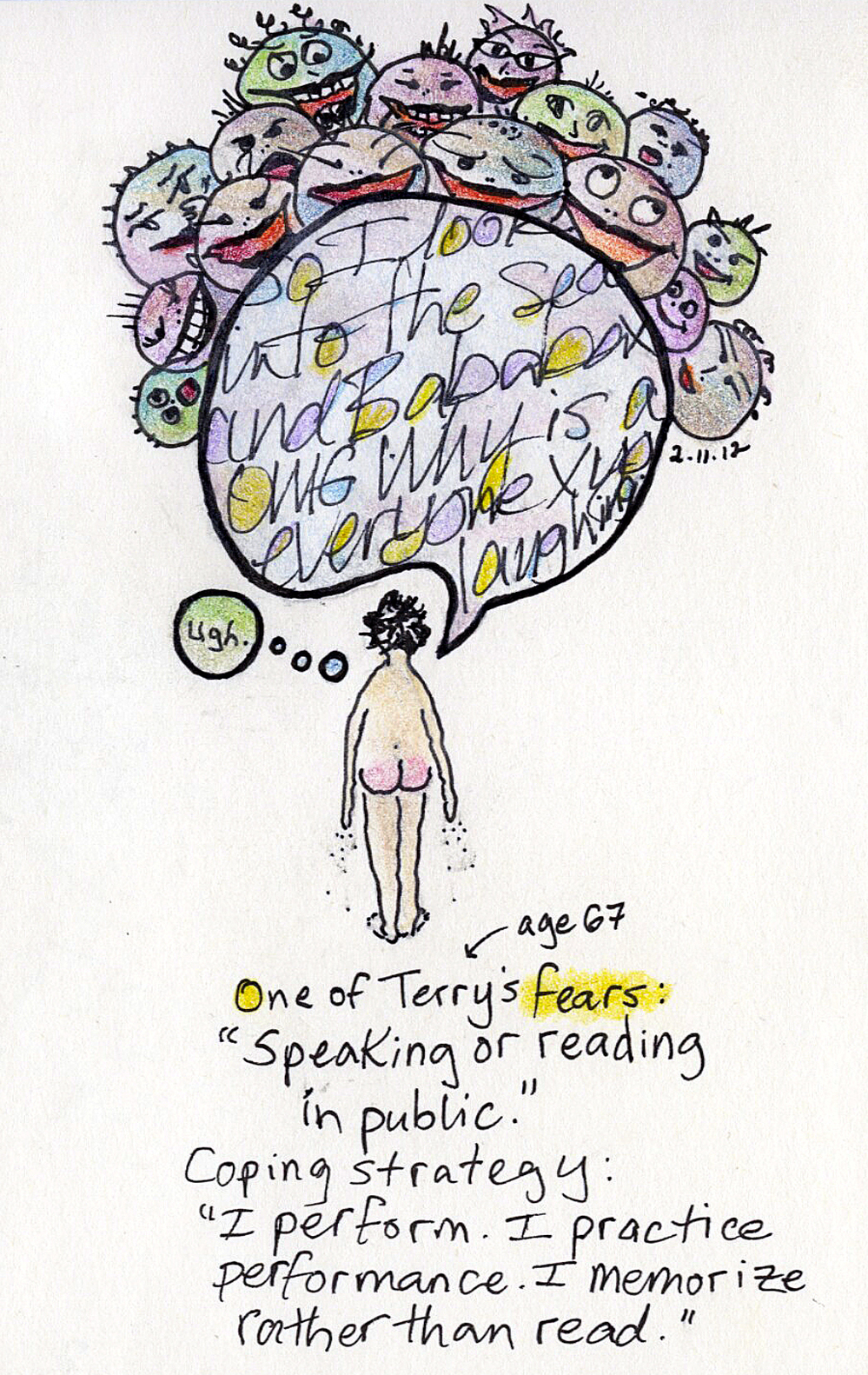
The idea is simple: She asks people about their fears and then lets her illustrative mind go wild. First, though, she wanted to draw her own fears — like getting a brain aneurysm or making a complete "ass" out of herself while playing the dulcimer.
Then she began interviewing the closest people around her, gathering and visually interpreting their fears. And in committing to the project, she was in a circuitous way confronting her own creative fears.
"It helped me believe in myself," she says. "I didn't really care if people liked them or not. I promised myself I'd do something every day, work fast, not redo and publish no matter what."
Janice, 56, fears for her special-needs child after she dies. Bill, 26, has a fear of small clusters of holes. Kate, 29, is simply scared of failing.
Elman started publishing her work on Facebook and was almost immediately overwhelmed by the response. People were commiserating over shared fears and commenting on how touched they were by her interpretations. Many have even found a form of therapy in the project.
Terry, 67, fears speaking or reading in public.
Courtesy of Julie M. Elman Terry, 67, fears speaking or reading in public.Courtesy of Julie M. Elman
"It transformed my fear somehow," says musician and singer Steve Eulberg, 57.
Eulberg was Elman's dulcimer instructor when he was diagnosed with thyroid cancer. Facing a potentially voice-altering surgery, he naturally feared the outcome. So Eulberg opened up to Elman, and she went to work.
"It is a unique way to honor someone's emotions," Eulberg says. When he went into surgery, he wrapped the illustration around a notebook and took it with him — almost like a talisman.
Just one month after his surgery, Eulberg says his voice has changed, but so has his outlook.
"I'm losing a few notes at the top, but maybe I'll gain a few at the bottom," he says.
Seventeen months and more than 125 illustrations later, Elman has discovered a power in the project that transcends her own creative revival:
"Fear is a big topic on how people conduct their lives, how people move forward," she says. "I'm just bringing it to the forefront visually."
As we were talking, I wondered if this project wasn't living somewhere inside Elman all along. After all, aren't most personal projects a return to what you love? She thought for a moment and said:
"In a way, it's how I started," recalling her days in junior high school when she'd ask people about their favorite colors or memories.
"And you know what I'd do," says Elman. "I would create little collages with their words, put a piece of saran wrap over it, and give it to them as a gift."
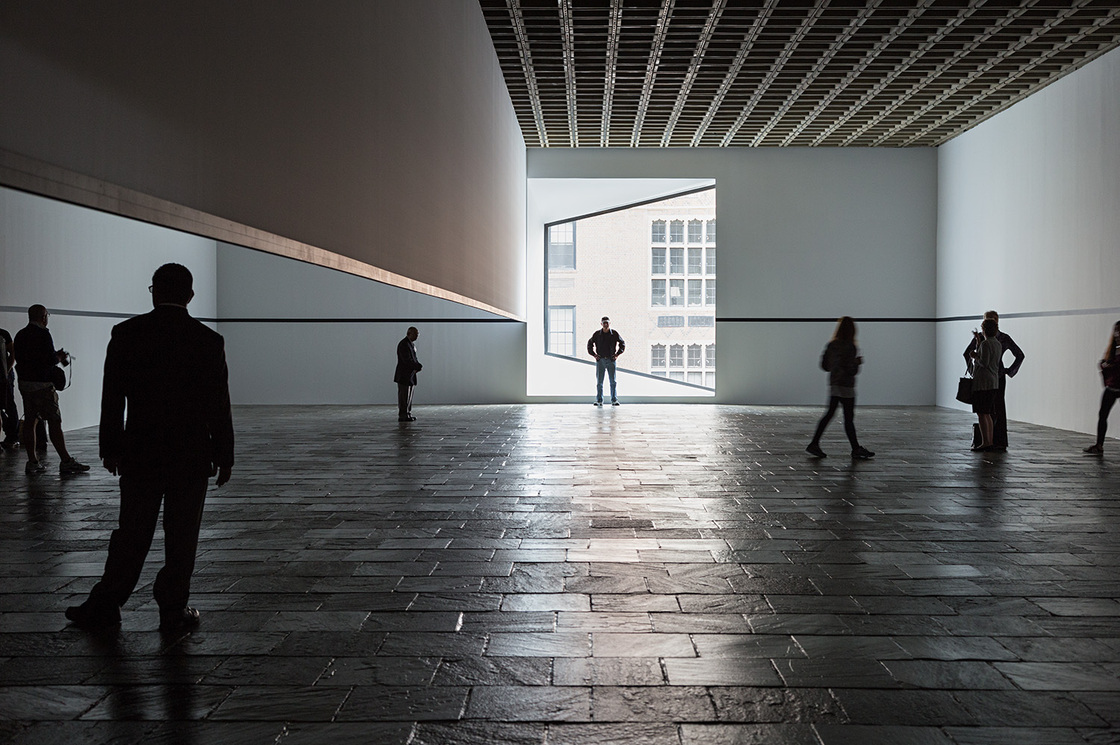
The elements of Robert Irwin's installation at the Whitney Museum of American Art — the show ends today — are named in the work's title: Scrim Veil—Black rectangle—Natural Light. There's no mystery. No magical ingredient.
It's a large rectangular room with a black floor divided lengthwise by a taut curtain of thin fabric hanging down to about head height; the fabric is translucent, from some angles invisibly transparent, from others impossible to see through; the fabric has a thick black border (another rectangle); there is a thick black line (rectangle) painted on the walls, bisecting them horizontally; light coming through a single large window at the end of the room.
A photo from the 1977 debut of Robert Irwin's Scrim Veil—Black Rectangle—Natural Light at the Whitney Museum of American Art.
And yet you could practically hear people gasp as they entered the room on the Whitney's fourth floor. Somehow the combined effect of the elements was not only gorgeous, but astonishing.
Yes, there was an optical trick. You could not always quite see the scrim. And because of the black bar of its border, and the similar bar on the wall behind, you had a sense that the two bars were one. You lost a sense of their location in space.
But the fascination of the piece doesn't come down to mere optical play.
I wish I understood what it does come down to.
One remarkable feature of the installation is that it has no focus. You're in it, for one thing, so you can't look at it. There isn't any one thing for you to contemplate. Or rather, everything — the window, the scrim, its border, the floor, the wall, the other people in the gallery — command attention equally.
Compare this with James Turrell's thematically kindred exhibition now at the Guggenheim just uptown. With Turrell you know just what to look at; there is something to inspect.
Or compare it with the installations of Richard Serra, which I've discussed here in the past. Serra's work disorients you and compels exploration. You can't just stand there. You need to do something.
But not so with Irwin. There is nothing to do here. Or, I suppose, there is everything to do. The installation is just a place. A place to be. It is a pure place. Space. And light. Could this be why it feels so good to be there?
You can keep up with more of what Alva Noë is thinking on Facebook and on Twitter: @alvanoe
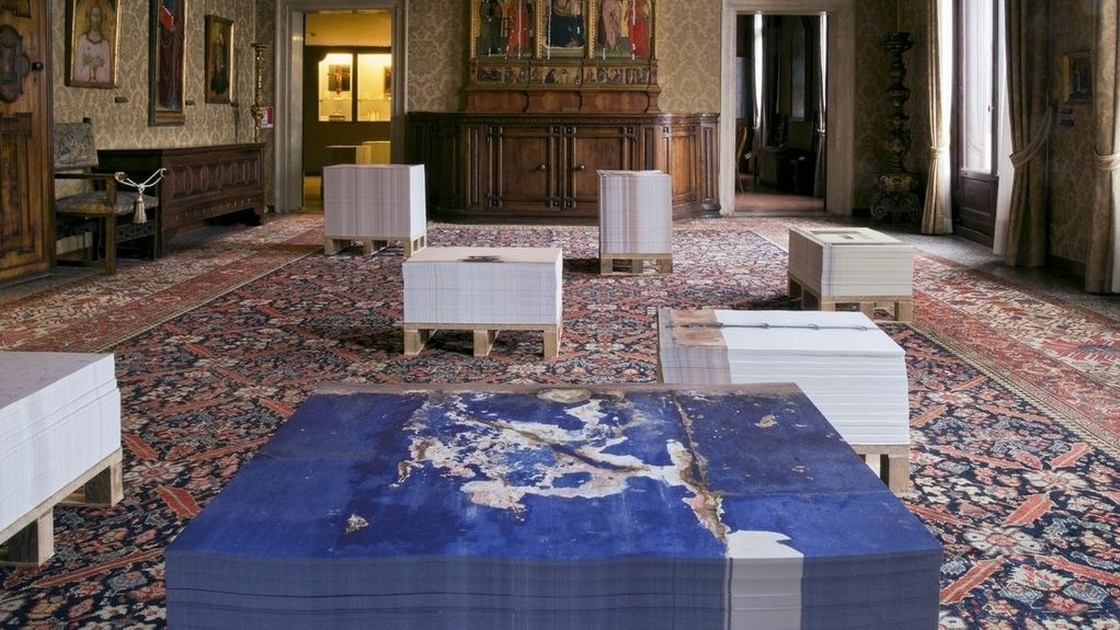
The Angolan exhibit consists of tall stacks of large photographic posters by artist Edson Chagas. The country, which is exhibiting at Venice for the first time, won the Golden Lion award for best national pavilion.
Courtesy of www.beyondentrophy.com The Angolan exhibit consists of tall stacks of large photographic posters by artist Edson Chagas. The country, which is exhibiting at Venice for the first time, won the Golden Lion award for best national pavilion.Courtesy of www.beyondentrophy.com
Every two years for over a century, lovers of contemporary art convene in Venice for the oldest and largest noncommercial art exhibition in the world.
The Venice Biennale has none of the glitz and conspicuous consumption of art auctions in London and New York. Instead, it's a dizzying and eclectic array of sights by both celebrity artists and total unknowns.
This year's works are not just paintings, sculptures and installations, but also performances, videos and music.
The French Pavilion intriguingly combines the last two: two films of two different pianists playing Maurice Ravel's Concerto in D for the left hand.
Art And The Subconscious
The Biennale is divided into two sections: 88 national pavilions, each with its own curator, and a central exhibition that includes more than 150 artists, chosen by the Biennale's artistic director, Massimiliano Gioni.
The theme is an imaginary museum that houses all worldly knowledge. Gioni wants to focus on how art reveals the subconscious in a society permeated by pop culture.
"The encyclopedic palace is about the desire to know and understand everything, a desire that recurs throughout history of art," he says. "What I'm asking is, how do we give form to our interior images when we're more and more besieged by artificial and external images?"
One of the most intriguing works is by British-born Tino Sehgal — a mysterious and ever-changing live performance that won the best artist prize. On a recent day, the performers are a young woman lying on the ground responding with movements and gestures to a young man improvising his own tune.
Other exhibits can be found scattered across the city, in palazzos and even churches.
Contrasting Exhibits
This year's Golden Lion award for best national pavilion went to Angola; the African country, long ravaged by war, is exhibiting here for the first time. Located in a palazzo rarely open to the public, the exhibit consists of tall stacks of large photographic posters, which visitors can take with them, by artist Edson Chagas.
The contrast inside the palazzo is striking — paintings by Botticelli and Piero della Francesca on the wall juxtaposed with Chagas' stylized photographs of found objects in the streets of the Angolan capital, Luanda.
The apparent serenity of the photos disturbs art critic Eurydice Trichon. She says she wants something that reflects nearly three decades of war, "something more expressive, something that accuse[s] ... humanity."
Giovanna Tissi, a spokeswoman for the pavilion, responds that African artists have had enough of war.
"They are really fed up with European culture that want[s] the African [to] still talk and show the blood," she says. "We want them showing the blood, but they don't want [to]."
Another war-torn country being showcased for the first time is Iraq. The pavilion's British curator traveled all over the country to find the artists and bring their works here.
The most haunting is Saddam Is Here, a series of photographs that captures ordinary people — a dentist, butcher, shepherd and a woman sitting on a couch — each holding a mask of the former Iraqi dictator over their face. Artist-photographer Jamal Penjweny says Saddam is still like a godfather in Iraq.
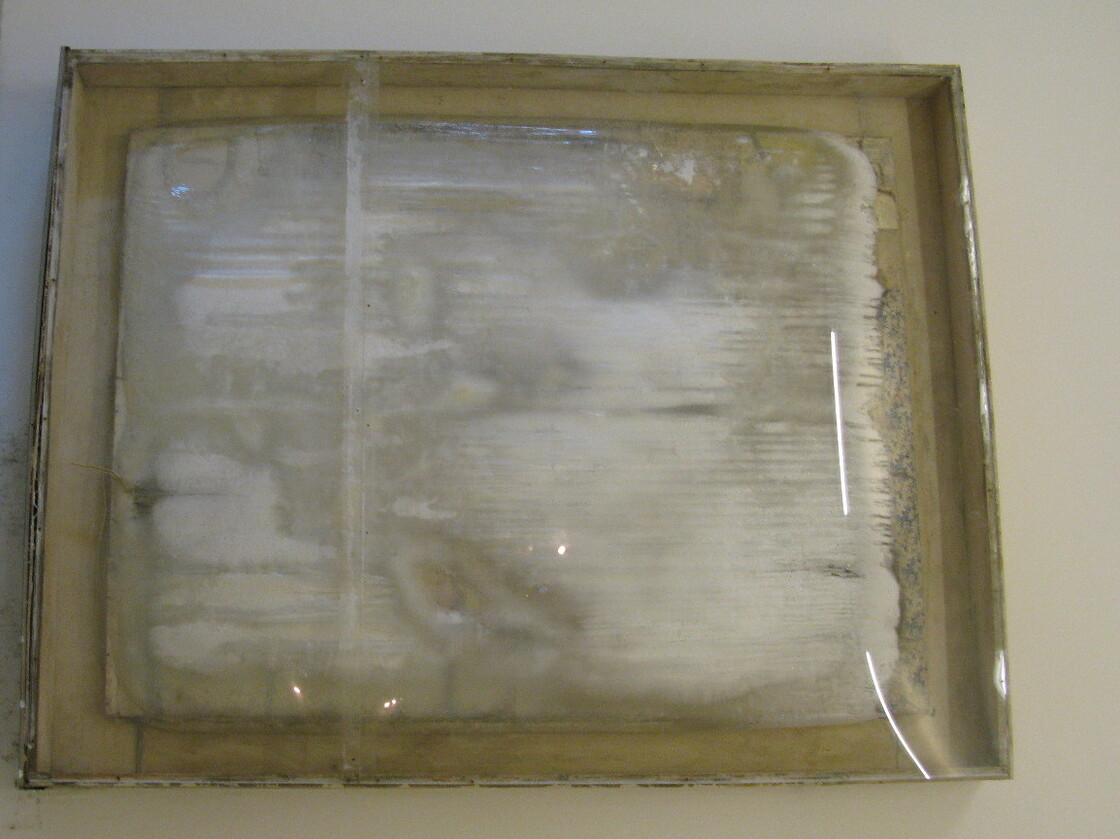
American artist Lawrence Carroll's work was commissioned by the Vatican.
Sylvia Poggioli/NPR American artist Lawrence Carroll's work was commissioned by the Vatican.Sylvia Poggioli/NPR
"After Saddam die[d], I saw the idea of Saddam Hussein in the way that people ... live, in the way the people ... [think], the way the people ... love," Penjweny says. "And I think you cannot transform [a] country to [a] democracy after you kill Saddam."
'It's Exciting, It's Modern'
Another first-time exhibitor is the Holy See. But the artworks couldn't be more different from the ancient and Renaissance masterpieces in the Vatican.
The visitor is welcomed by a thumping heartbeat and wall-to-wall videos by an Italian multimedia group, stark photographs of ruins and abandoned buildings by Czech photographer Joseph Koudelka, and abstract white canvases — one frozen in ice — by American artist Lawrence Carroll.
The artists say the Vatican gave them total freedom, and the pavilion has been widely praised for showing the church's willingness to engage with the contemporary world. Negative reactions came mostly from conservative Catholics.
Many visitors find the sheer numbers of artists, pavilions and special exhibits on the sidelines of the Biennale daunting, and it takes several days to see it all.
Nancy Downer, an American biochemist who lives in Rome, is already on her second visit.
"It's exciting; it's modern," she says. "But what struck me is how intellectual much of it is. It's all about what people are thinking, so, you don't get any easy images of pretty things."
Carroll, the American artist whose works were commissioned by the Vatican, says the beauty of the Biennale is not just having his work seen, but having it seen in the context and in dialogue with works of other artists from all over the world.
"Art throughout history has been a bridge, a meeting point," Carroll says. "Art does have the ability to move and change things, and I think that's quite a wonderful thing."
Hide caption Training on the beach outside Barcelona, Spain, 1936 Gerda Taro/International Center of Photography Hide caption A U.S. Marine Corps drill instructor delivers a severe reprimand to a recruit, Parris Island, S.C., 1970. Hide caption Boarding of the transport ship Ajana, Melbourne, Australia, 1916 Hide caption Muchachos await counterattack by the National Guard, Matagalpa, Nicaragua, 1978 Hide caption A U.S. Marine of the 1st Division carries a GI Joe mascot as a good luck charm as his unit pushes farther into the western part of Fallujah, Iraq, 2004. Dmitri Baltermants/Russian Photo Association Hide caption Sgt. William Olas Bee, a U.S. Marine from the 24th Marine Expeditionary Unit, has a close call as Taliban fighters open fire near Garmsir in Helmand province, Afghanistan, 2008. Hide caption Death of a Marine at Dyala Bridge, near Baghdad, Iraq, 2003 Hide caption An American soldier reads a letter from home while taking a break from repairing a tank tread in Lang Vei, Vietnam, 1971. David Burnett/Contact Press Images Hide caption Navy Chaplain Lt. Commander Tom Webber baptizes Cpl. Albert Martinez in a sandbag-lined pool during a ceremony at Camp Inchon, Kuwait, 2003. Hayne Palmour IV/U-T San Diego Hide caption Danh Son Huol, an ethnic Khmer guerrilla, is treated by a medical unit in a swamp in U Minh Forest, Ca Mau peninsula, Vietnam, 1970. Hide caption Dying infant found by American soldiers in Saipan, 1944 Hide caption A Bosnian soldier stands on what is believed to be a mass grave outside his destroyed home. He was the sole survivor of a massacre that left 69 people dead, including his family, 1995. Hide caption Congolese women flee to Goma, in the Democratic Republic of Congo, 2008. Hide caption Valentine with her daughters, Amelie and Inez, Rwanda, 2006 Peter van Agtmael/Magnum Photos
D-Day soldiers landing on Omaha Beach. A naked Vietnamese girl running from napalm. A Spanish loyalist, collapsing to the ground in death. These images of war, and some 300 others, are on view at the Corcoran Gallery of Art in Washington, D.C., in an exhibition called WAR/PHOTOGRAPHY: Images of Armed Conflict and Its Aftermath. Pictures from the mid-19th century to today, taken by commercial photographers, military photographers, amateurs and artists capture 165 years of conflict.
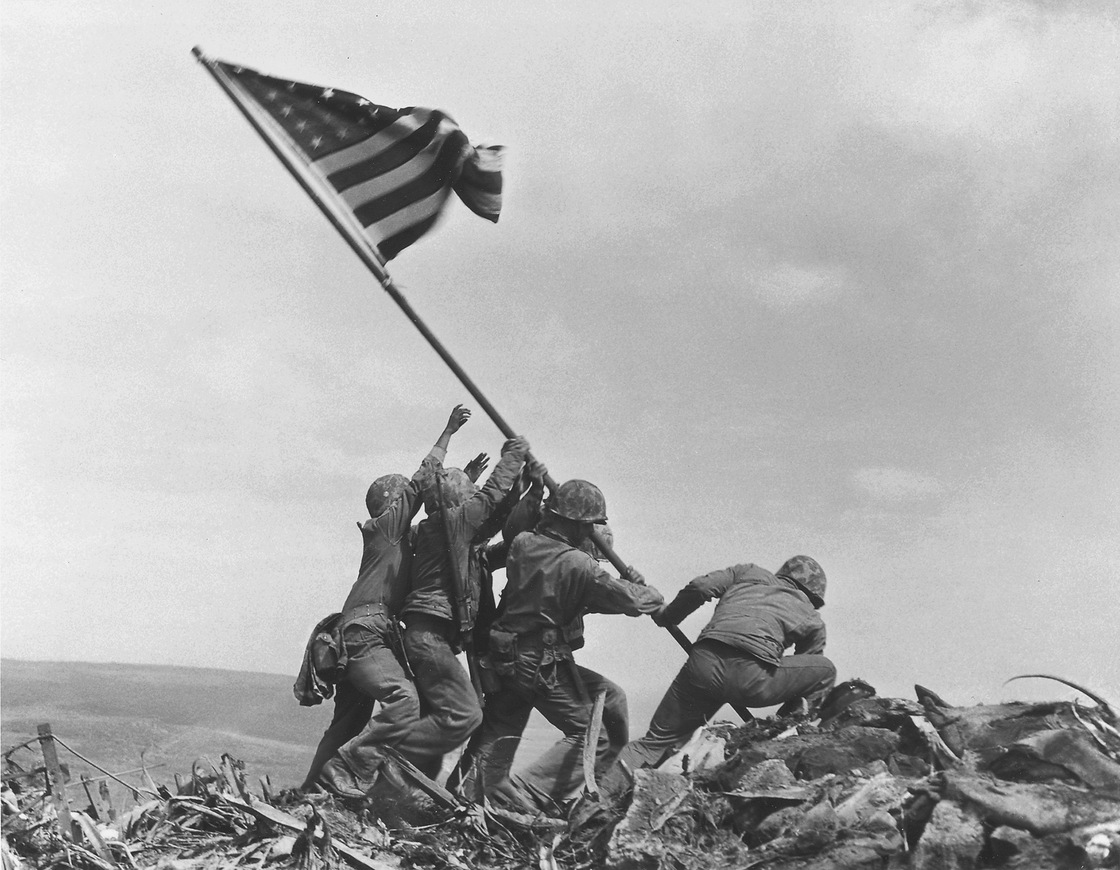
U.S. Marines of the 28th Regiment, 5th Division, raise the American flag atop Mount Suribachi, Iwo Jima, on Feb. 23, 1945.
Joe Rosenthal/AP U.S. Marines of the 28th Regiment, 5th Division, raise the American flag atop Mount Suribachi, Iwo Jima, on Feb. 23, 1945.Joe Rosenthal/AP
One of the best-known war pictures of all time was taken by AP photographer Joe Rosenthal in 1945. Five Marines and a Navy corpsman, raising the American flag on Mount Suribachi, Iwo Jima.
"It's such an important and historic photograph, but I don't know who any of those guys are," says documentary photographer Louie Palu — who found inspiration in the iconic Rosenthal image. "I wanted to meet the guys in that photograph. I wanted to know the name, the age, how young or how old they looked. I didn't want it to be an anonymous set of people raising a flag."
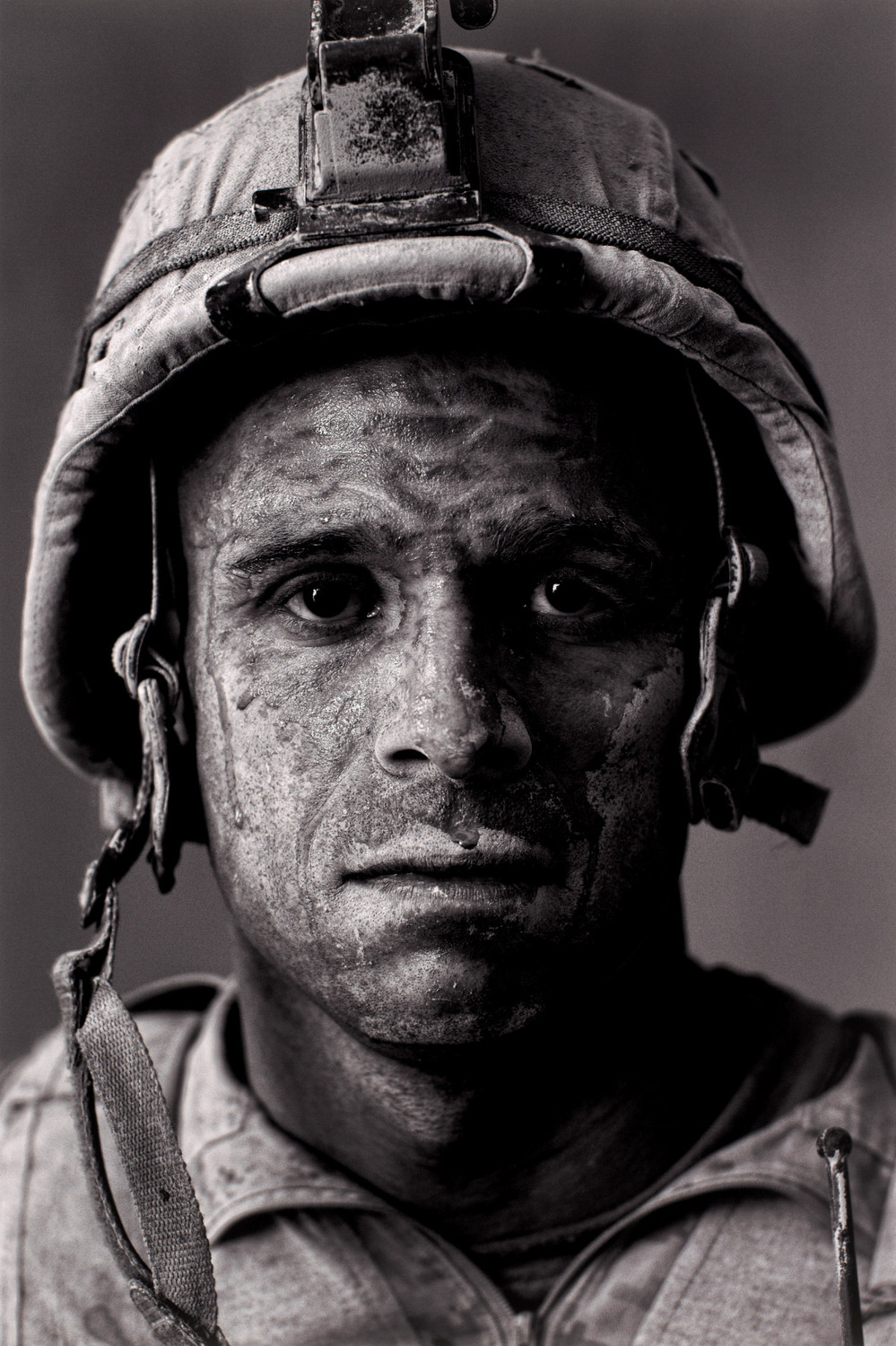
So when Palu was embedded with troops in Afghanistan's Helmand province in 2008, he made close-up portraits of the men. One of Palu's portraits became the signature image of this war photography show:
It shows 31-year-old U.S. Marine Gunnery Sgt. Carlos "OJ" Orjuela. His face, under his helmet, is caked with mud and sweat and exhaustion. He'd served in Iraq and then Afghanistan. His eyes look as if they have seen everything, and tomorrow they'll have to see some more. His face says "I want to go home," Palu says.
At the Corcoran, wall after wall, photo after photo — black and white, color, by men and women famous and unknown. In this day of the moving image — on movie screens, TV screens, smartphones — curator Anne Tucker says still pictures like these remain for a reason.
U.S. Marine Gunnery Sgt. Carlos "OJ" Orjuela, 31, in Garmsir District, Helmand province, Afghanistan.
Louie Palu/The Museum of Fine Arts, Houston U.S. Marine Gunnery Sgt. Carlos "OJ" Orjuela, 31, in Garmsir District, Helmand province, Afghanistan.Louie Palu/The Museum of Fine Arts, Houston
"Still photographs log into our brains differently than moving pictures," says Tucker, who originated the show at the Museum of Fine Arts, Houston. "And therefore they still have power and they still connect with us."
They're frozen moments. Not ever-changing blinks. They make us stop and look.
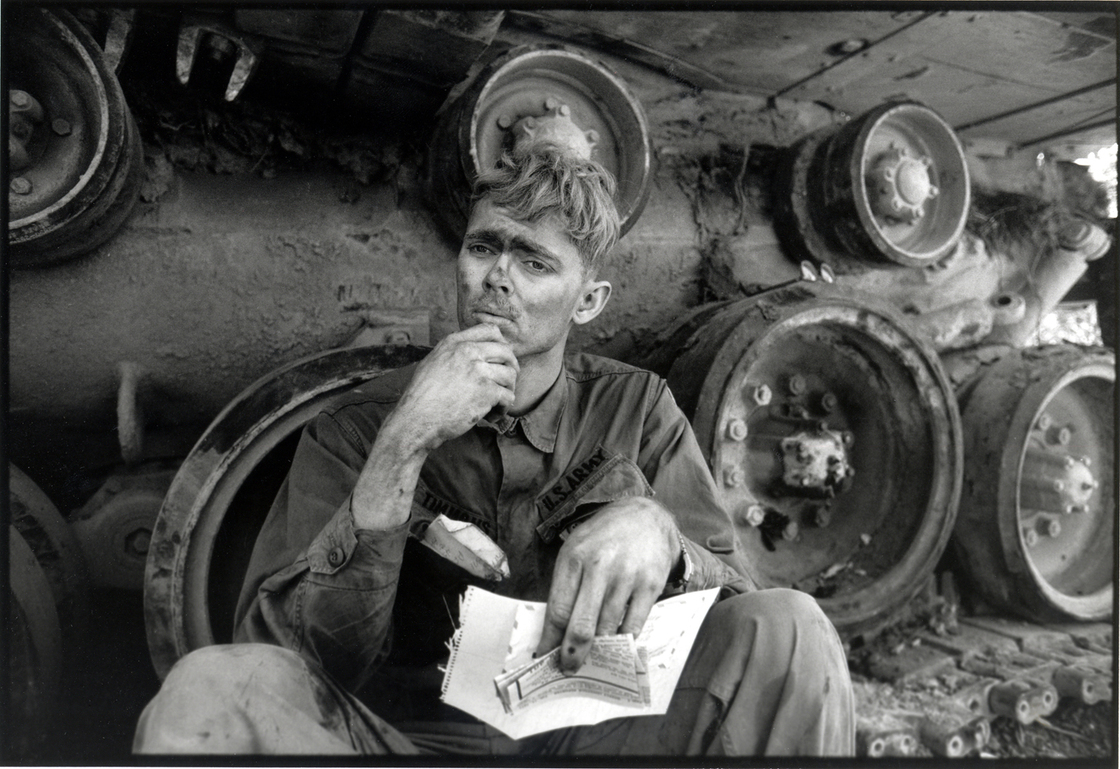
You can't take your eyes off the beautiful young soldier with the chiseled cheeks and dirty clothes in a photograph taken in Vietnam in 1971. Resting for a moment, the man sits on the broken track of an armored personnel carrier he's repairing. With long, soiled fingers he holds a clipping from some weekly livestock report. He stares into space. Photojournalist David Burnett took this picture.
"He almost has what they used to call the thousand-yard stare," Burnett says. "He's thinking. I don't know what he's thinking. He's reading a letter from home and it's just a picture that kind of captures him in this moment of pondering what the rest of his life was like when he wasn't being a combat soldier."
Burnett didn't know right away what a powerful image he'd gotten: "My film went into an envelope, was sent to Saigon, was put on a plane, it went to New York, it was developed, it was edited, and the first I even saw the picture was about 10 days later when Time magazine published the photograph."
Burnett didn't get the soldier's name, or age, or hometown, and he regrets that.
"Every time I walk into a diner now and I'll see a couple of Vietnam vets sitting around talking I'll just wonder, could this be the guy from my picture? I would love to be able to find him before one of us passes away," he says.
An American soldier reads a letter from home, while taking a break from repairing a tank tread in Lang Vei, Vietnam, in March 1971.
David Burnett/Contact Press Images An American soldier reads a letter from home, while taking a break from repairing a tank tread in Lang Vei, Vietnam, in March 1971.David Burnett/Contact Press Images
Burnett and the young tank repairman made an anonymous passage through one another's lives. And yet that soldier haunts the photographer.
"Now, 42 years later — just to go have a cup of coffee with this guy — I'd love to do that," Burnett says.
What's the purpose of these pictures? Image after image of men, mostly, at war, carrying guns, under fire, running from — or toward — danger. Killing, being killed.
"We need to tell the public, the public of the entire world what war is really like," says photo editor John Morris. During World War II, Morris ran Life magazine's London office. He was photographer Robert Capa's editor, and later the picture editor at The New York Times and the Washington Post. Morris says the public doesn't get to see everything — not all of war's brutalities.
"As a picture editor, I've often had to make decisions about what the public needs to see and what is going to make the reader throw up," Morris says. "It's a fine line. At The New York Times, I had a bottom drawer full of pictures that were unpublishable, mostly because they were too much to take. One doesn't want to wipe the public in blood. One wants to get the public to learn to avoid bloodshed."
Even if the bloodiest images were published, Afghanistan photographer Louie Palu says war pictures still miss some important elements.
"I'm not really showing what it's like," he says. "You have to imagine people screaming and moaning, the last sound before they die, the smell, men weeping, the sound of flesh as people drag a casualty down a trench."
When the design company Paul Frank threw a powwow themed party, a lot of people were offended. But rather than just issue an apology, the company teamed up with Native American designers for a new line. Guest host Celeste Headlee finds out more.
And now we turn to a very different kind of fashion/history story. Last year, clothing and accessories line Paul Frank hosted a powwow and dreamcatcher party that offended a lot of people, not just Native Americans. Bloggers like Adrienne Keene demanded an apology and the company obliged. But Paul Frank Industries didn't stop there. They decided to team up with Native designers to create a line that showcases art from the many Native American cultures.
That line launches today. And joining us to talk more about it is Elie Dekel. He's the president of Saban Brands, that's the parent company of Paul Frank Industries. And also with us, Adrienne Keene, she writes the popular blog "Native Appropriations" and is a member of the Cherokee Nation of Oklahoma. Welcome back to both of you.
ADRIENNE KEENE: Thanks so much for having me.
ELIE DEKEL: Thanks, Celeste. Great to be here.
HEADLEE: Adrienne, take us back to, kind of, the beginning of this story and the moment when you found out about this powwow-themed party. You wrote about it pretty strongly in your blog. What exactly in it was offensive?
KEENE: Well, it was back in September, and it was actually thanks to Jessica Metcalfe, who is another blogger who's worked with us really closely on this collaboration and definitely, we wouldn't be here without her. She got a Google alert for Native American and fashion and found the images from this party from Fashion's Night Out. And I think to us in the Native community, some of the things that stood out immediately were the kind of mishmash of a lot of different tribal cultures being put together under this one, sort of, blanket theme, of quote-unquote, Native American. And Julius, who's the mascot of Paul Frank, was in a headdress, kind of the stereotypical war bonnet.
And for the communities that wear the headdress, that's something that's extremely sacred and something that you have to earn. And so seeing images like that - having the headdress on a monkey, seeing people dress up and play Indian. There were tomahawks and some sort of some mock-scalpings and things like that. To me, it was just really hurtful, and kind of pointed to a lot of the misunderstandings about Native communities in our country.
HEADLEE: Well, Elie, you obviously were made aware of these reactions to it. How quickly did you and the rest of the company realize it was a mistake?
DEKEL: Well, it was fascinating. The power of social media works at light speed. And I have to say, within probably 12 hours...
HEADLEE: Wow.
DEKEL: ...Of the event itself, we were starting to see reaction bubble up on various social media platforms, and particularly led by Adrienne and Jessica's blogs. And it was alarming at first. This was - you know, Paul Frank is a joyful brand that appeals to all ages all around the world. And the furthest thing from our mind would be to do anything that would be perceived offensive or perhaps misappropriated. But it really came out of a sincere desire to tap into trends, and we were seeing fashion trends evolving where Native American style was coming to light and we, unfortunately, adapted in a way that was inappropriate.
And boy, when we saw the social media reaction, and particularly when we had a chance to speak with both Jessica and Adrienne, we understood much more clearly where we had gone wrong and realized that this was more than just a mistake, this was something that required and in our view was really deserving of a much more thorough discussion and a much more thorough education process for the licensing and the fashion industry.
HEADLEE: Well, Adrienne, then tell me about some of these initial conversations. I mean, it must've been a surprise to you that the company would actually reach out and talk to you personally and do more than the apology. But what do you think about the way in which this whole thing transpired, and what this means for, maybe times in the future when this sort of thing happens?
KEENE: It was amazing to open up my e-mail that day and see the e-mail directly from Elie. I've been doing this blog for three years now, I push back on companies all the time. This is a trend that really hasn't gone away since the beginning of the founding of the United States. So I push back a lot. I never had received any sort of response like we did from Paul Frank. And in that initial phone call, I was really nervous and I'm sure the company was nervous as well. I didn't know what to expect. I didn't know if I was going to have to be defensive. I didn't know if I was going to have to sort of fight for my position on this.
But from the beginning, everyone I've worked with has been so gracious and went above and beyond what I could have even imagined for a positive outcome from this. So it's been a long process, but it's really been something that's been incredible to see, and I really hope that this collaboration that we've developed can serve as a model for other companies, because there's a lot of arguments out there that I hear from companies that things like pulling products from the shelves or telling manufacturers to cease using a design or doing things that scale are just impossible. But this collaboration with Paul Frank has shown that all of those things are very possible if there's just the dedication from the company. So I'm hoping that this really can serve as a model for other companies that want to showcase these Native designs, but do it right.
HEADLEE: Well, let's talk about that collaboration then. Because the line launches today. And Elie, I wanted to talk to you about this team of Native designers that helped you. And maybe you can tell us a little bit about the line, what does it look like?
DEKEL: Well, it's - the team was really pulled together through, again, the ongoing collaboration of working with Adrienne and Jessica, who have a much greater insight into the creative and fashion community endemic to Native Americans. And so one of the things that was obvious to us in understanding the issues was that you can't say Native American and believe to include all of the different cultures and peoples and - that span this great nation. And so it was important for us, as we thought about doing this the right way, that we also tried to represent a cross-section of influences from different tribes and different nations within the Native American community.
And so working together, we identified four designers - Louie Gong who's a Nooksak heritage, Candace Halcro, Plains Cree/Metis Tribe, Dustin Martin, who is Navajo, and Autumn Dawn Gomez, who comes from the Comanche/Taos tribes. Each of them brings not only a unique artistic style, but they also operate in different mediums. One - and then lastly, they also represent a cross-section. And so together we've come together with a line of product that ranges from tote bags, pillowcases, and throw blankets to hand-beaded fashion eyewear. Fashion eyewear has always been a part of the Paul Frank business and now we have a created, inspired line. Dustin worked on some really powerful graphics for a t-shirt line. And we also have jewelry from Autumn, who also applied a very unique method, but also her heritage, her style, her artistic expression and doing so in a very positive integration of the Paul Frank brand, which I mentioned before, has a universal appeal and a very joyful appeal.
So it was important to us in trying to perhaps outdo the negatives that we had done before in this naive event that we threw. It was important for us to really try and amplify the issues in each aspect of this collaboration - the diversity, the multiple mediums, the different nations that are represented, and then allow that to flourish in its own right, and it's a symbolic week for us to release this collection now, because this week in New Mexico is the big SWAIA conference, which pulls together, I believe it's the largest gathering of Native Americans of the year in Santa Fe. And so to do all that, working with the community in an endemic and sincere and authentic fashion, has been an incredibly refreshing experience for us. And one that we hope will be looked at by others in the fashion design and licensing industries as a template, if you will, for how to approach working with different cultures, working with different sensibilities.
HEADLEE: That's Elie Dekel, president of Sabon Brands, the company that owns Paul Frank Industries. That line he's talking about launches today. He joined us from our studios at NPR West. And Adrienne Keene is the creator and blogger for "Native Appropriations." She joined us from Encinitas, California. Thank you both.
KEENE: Thank you so much.
HEADLEE: That's our program for today. I'm Celeste Headlee. You've been listening to TELL ME MORE from NPR News and we'll talk more tomorrow.
Hide caption Robert Dighton's 1805 full-length watercolor portrait, seen at right, is the singular extant image of the young George Bryan "Beau" Brummell. It was made during the height of Brummell's social and sartorial prominence within the aristocratic circles of early 19th-century Regency England. Hide caption Richard Dighton (1795-1880) was Robert Dighton's son. His 1823 Mirror of Fashion is a panoramic depiction of 53 "dandies of the day." Yale Center for British Art, Paul Mellon Collection Hide caption In his youth, even before he cavorted with Beau Brummell, the future George IV took liberties in his dress that are particularly evident in this exotic chintz banyan from the 1780s. A quilted and printed loosely cut robe meant for the intimacy of the home environment, the banyan alluded to the mysteries and pleasures of Middle East and Asia. Brighton Royal Pavilion and Museums. Hide caption Publications such as the influential fashion journal Gazette du Bon Ton featured illustrations like this one from 1913 by Bernard Boutet de Monvel, which depicts the life of the flaneur, or the fashionable man on the street. Hide caption In this ensemble, styled by Motofumi "Poggy" Kogi, the Hello Kitty character takes in London's sights and serenely drinks tea amid a whirlwind of pattern and color. A collaboration between Sanrio's Hello Kitty and Liberty of London, the fabric reflects a long history of exchange. Hide caption Sartorial Anarchy #5, 2012. Ike Ude, photographer. In his Sartorial Anarchy self-portraits, New Yorkâ??based Nigerian-born artist Ike Ude creates composite images of the dandy across geography and chronology. Ude photographs himself in disparate ensembles, pairing, for example, a copy of an 18th-century Macaroni wig with other carefully selected vintage garments and reproductions. Courtesy of Leila Heller Gallery Ike Ude
When you hear the word dandy, what do you think of?
Maybe the song "Yankee Doodle Dandy," which dates all the way back to the Revolutionary War, and compares the colonists to foppish, effeminate idiots: the dandies.
But a summer exhibit at the Rhode Island School of Design Museum, closing Aug. 18, aims to reclaim the term. It explores dandyism through the ages, linking to the cutting edge of men's fashion and style. The name of the show is "Artist, Rebel, Dandy: Men of Fashion" — which does still leave you wondering what you might see.
"Am I going to see purple? Am I going to see lace?" asks assistant curator Laurie Brewer. "Am I going to see ruffles? What does dandy mean in the contemporary context?"
Brewer and her fellow curator Kate Irvin put a lot of thought into the question of what a dandy really is. "It's about being an individual, and expressing yourself creatively with certain passions and flair," says Irvin.
The Nap Anywhere is a new, portable head-support pillow created by a Virginia-based physician.
Courtesy of Nap Anywhere The Nap Anywhere is a new, portable head-support pillow created by a Virginia-based physician.Courtesy of Nap Anywhere
In our "Weekly Innovation" blog series, we explore an interesting idea, design or product that you may not have heard of yet. Previously we've featured the sink-urinal and Smart Bedding. (Do you have an innovation to share? Use this quick form.)
The familiar U-shaped inflatable travel pillow just wasn't doing it for Ravi Shamaiengar. The Virginia-based doctor is a frequent business traveler, and after years of thinking that the standard travel pillow was a hassle that left his neck sore, he took matters into his own hands and tinkered his way to an invention: The Nap Anywhere.
The Nap Anywhere is a thin foam disk with a strong but bendy middle. The top part of it folds into a shelf that molds to support your head and neck. The bottom part of the bendy disk can be shaped to mold over your shoulder. When you're finished with it, it flattens into its original shape for easy packing. (You can watch this video to see how it works.)
The radiologist and health journal publisher turned inventor says he's been working on the design for years in his garage, in his spare time.
"I made the template out of chicken wire and it worked better than anything I'd used before," Shamaiengar tells NPR. "I had to figure out how to construct it, so I hired an engineering company, and two years later, I launched my project."
In 2012, the Nap Anywhere made its debut at the Virginia Inventors Forum and took home the top prize of Innovation of the Year. The win inspired the doctor to start a campaign on crowd-funding platform Kickstarter last month. The effort to raise $40,000 to start manufacturing the Nap Anywhere exceeded its goal, and the doctor says a factory will start making the first batch of these foam pillows — about 3,000 of them — by September. About half of those will go to the Kickstarter backers of the project. The rest will be available to order, starting at $49, on the Nap Anywhere site in a few weeks.
While we think this would be a perfect product to market on the kitschy in-flight catalog SkyMall, Shamaiengar hasn't thought that far ahead.
"I'm not a typical entrepreneur," he says. "This device I made for me. I didn't really have any aspiration to make it for other people. But after I made it, people who saw it said, 'This thing is so awesome, you should make it for others.' Now this will probably help more people than I help as a physician. This might be the biggest accomplishment I will have."
 Hide caption Janice, 56, fears for her special-needs child, Bryce, 31.

 Hide caption Nomophobia: Fear of being separated from one's cellphone.
  Hide caption
  Hide caption Kate, 59, fears being in a nursing home or hospital, and having a TV going all day.
  Hide caption Marcy, 60, fears not having her camera to record a big moment.
  Hide caption Anonymous fears working so hard that they forget to live.
  Hide caption Michelle, 22, fears making the wrong decisions in life.
  Hide caption Steve, 54, fears having his voice changed, altered or lost.
  Hide caption Anna, 19, fears getting her back broken and having to be in a wheelchair.
  Hide caption Catherine, 26, fears not knowing how rheumatoid arthritis will affect her joints.
  Hide caption Nic, 29, fears the idea of being wrongfully imprisoned.
  Terry, 67, fears speaking or reading in public.Courtesy of Julie M. Elman
 Visitors explore Robert Irwin's Scrim Veil—Black Rectangle—Natural Light during its 2013 reprise at the Whitney Museum of American Art.©Robert Irwin/Photography ©2013 Philipp Scholz Rittermann/Courtesy of the Whitney Museum
 The Angolan exhibit consists of tall stacks of large photographic posters by artist Edson Chagas. The country, which is exhibiting at Venice for the first time, won the Golden Lion award for best national pavilion.Courtesy of www.beyondentrophy.com
  American artist Lawrence Carroll's work was commissioned by the Vatican.Sylvia Poggioli/NPR
  Hide caption Training on the beach outside Barcelona, Spain, 1936 Gerda Taro/International Center of Photography
  Hide caption A U.S. Marine Corps drill instructor delivers a severe reprimand to a recruit, Parris Island, S.C., 1970.
  Hide caption Boarding of the transport ship Ajana, Melbourne, Australia, 1916
  Hide caption Muchachos await counterattack by the National Guard, Matagalpa, Nicaragua, 1978
  Hide caption A U.S. Marine of the 1st Division carries a GI Joe mascot as a good luck charm as his unit pushes farther into the western part of Fallujah, Iraq, 2004.
  Dmitri Baltermants/Russian Photo Association
  Hide caption Sgt. William Olas Bee, a U.S. Marine from the 24th Marine Expeditionary Unit, has a close call as Taliban fighters open fire near Garmsir in Helmand province, Afghanistan, 2008.
  Hide caption Death of a Marine at Dyala Bridge, near Baghdad, Iraq, 2003
  Hide caption An American soldier reads a letter from home while taking a break from repairing a tank tread in Lang Vei, Vietnam, 1971. David Burnett/Contact Press Images
  Hide caption Navy Chaplain Lt. Commander Tom Webber baptizes Cpl. Albert Martinez in a sandbag-lined pool during a ceremony at Camp Inchon, Kuwait, 2003. Hayne Palmour IV/U-T San Diego
 Hide caption Danh Son Huol, an ethnic Khmer guerrilla, is treated by a medical unit in a swamp in U Minh Forest, Ca Mau peninsula, Vietnam, 1970.
  Hide caption Dying infant found by American soldiers in Saipan, 1944
  Hide caption A Bosnian soldier stands on what is believed to be a mass grave outside his destroyed home. He was the sole survivor of a massacre that left 69 people dead, including his family, 1995.
  Hide caption Congolese women flee to Goma, in the Democratic Republic of Congo, 2008.
  Hide caption Valentine with her daughters, Amelie and Inez, Rwanda, 2006
  Peter van Agtmael/Magnum Photos
  U.S. Marines of the 28th Regiment, 5th Division, raise the American flag atop Mount Suribachi, Iwo Jima, on Feb. 23, 1945.Joe Rosenthal/AP
  U.S. Marine Gunnery Sgt. Carlos "OJ" Orjuela, 31, in Garmsir District, Helmand province, Afghanistan.Louie Palu/The Museum of Fine Arts, Houston
  An American soldier reads a letter from home, while taking a break from repairing a tank tread in Lang Vei, Vietnam, in March 1971.David Burnett/Contact Press Images
  Hide caption In his youth, even before he cavorted with Beau Brummell, the future George IV took liberties in his dress that are particularly evident in this exotic chintz banyan from the 1780s. A quilted and printed loosely cut robe meant for the intimacy of the home environment, the banyan alluded to the mysteries and pleasures of Middle East and Asia. Brighton Royal Pavilion and Museums.
  Hide caption Publications such as the influential fashion journal Gazette du Bon Ton featured illustrations like this one from 1913 by Bernard Boutet de Monvel, which depicts the life of the flaneur, or the fashionable man on the street.
  Hide caption Sartorial Anarchy #5, 2012. Ike Ude, photographer. In his Sartorial Anarchy self-portraits, New Yorkâ??based Nigerian-born artist Ike Ude creates composite images of the dandy across geography and chronology. Ude photographs himself in disparate ensembles, pairing, for example, a copy of an 18th-century Macaroni wig with other carefully selected vintage garments and reproductions. Courtesy of Leila Heller Gallery Ike Ude
  The Nap Anywhere is a new, portable head-support pillow created by a Virginia-based physician.Courtesy of Nap Anywhere