The elements of Robert Irwin's installation at the Whitney Museum of American Art — the show ends today — are named in the work's title: Scrim Veil—Black rectangle—Natural Light. There's no mystery. No magical ingredient.
It's a large rectangular room with a black floor divided lengthwise by a taut curtain of thin fabric hanging down to about head height; the fabric is translucent, from some angles invisibly transparent, from others impossible to see through; the fabric has a thick black border (another rectangle); there is a thick black line (rectangle) painted on the walls, bisecting them horizontally; light coming through a single large window at the end of the room.
A photo from the 1977 debut of Robert Irwin's Scrim Veil—Black Rectangle—Natural Light at the Whitney Museum of American Art.
And yet you could practically hear people gasp as they entered the room on the Whitney's fourth floor. Somehow the combined effect of the elements was not only gorgeous, but astonishing.
Yes, there was an optical trick. You could not always quite see the scrim. And because of the black bar of its border, and the similar bar on the wall behind, you had a sense that the two bars were one. You lost a sense of their location in space.
But the fascination of the piece doesn't come down to mere optical play.
I wish I understood what it does come down to.
One remarkable feature of the installation is that it has no focus. You're in it, for one thing, so you can't look at it. There isn't any one thing for you to contemplate. Or rather, everything — the window, the scrim, its border, the floor, the wall, the other people in the gallery — command attention equally.
Compare this with James Turrell's thematically kindred exhibition now at the Guggenheim just uptown. With Turrell you know just what to look at; there is something to inspect.
Or compare it with the installations of Richard Serra, which I've discussed here in the past. Serra's work disorients you and compels exploration. You can't just stand there. You need to do something.
But not so with Irwin. There is nothing to do here. Or, I suppose, there is everything to do. The installation is just a place. A place to be. It is a pure place. Space. And light. Could this be why it feels so good to be there?
You can keep up with more of what Alva Noë is thinking on Facebook and on Twitter: @alvanoe
Hide caption Robert Dighton's 1805 full-length watercolor portrait, seen at right, is the singular extant image of the young George Bryan "Beau" Brummell. It was made during the height of Brummell's social and sartorial prominence within the aristocratic circles of early 19th-century Regency England. Hide caption Richard Dighton (1795-1880) was Robert Dighton's son. His 1823 Mirror of Fashion is a panoramic depiction of 53 "dandies of the day." Yale Center for British Art, Paul Mellon Collection Hide caption In his youth, even before he cavorted with Beau Brummell, the future George IV took liberties in his dress that are particularly evident in this exotic chintz banyan from the 1780s. A quilted and printed loosely cut robe meant for the intimacy of the home environment, the banyan alluded to the mysteries and pleasures of Middle East and Asia. Brighton Royal Pavilion and Museums. Hide caption Publications such as the influential fashion journal Gazette du Bon Ton featured illustrations like this one from 1913 by Bernard Boutet de Monvel, which depicts the life of the flaneur, or the fashionable man on the street. Hide caption In this ensemble, styled by Motofumi "Poggy" Kogi, the Hello Kitty character takes in London's sights and serenely drinks tea amid a whirlwind of pattern and color. A collaboration between Sanrio's Hello Kitty and Liberty of London, the fabric reflects a long history of exchange. Hide caption Sartorial Anarchy #5, 2012. Ike Ude, photographer. In his Sartorial Anarchy self-portraits, New Yorkâ??based Nigerian-born artist Ike Ude creates composite images of the dandy across geography and chronology. Ude photographs himself in disparate ensembles, pairing, for example, a copy of an 18th-century Macaroni wig with other carefully selected vintage garments and reproductions. Courtesy of Leila Heller Gallery Ike Ude
When you hear the word dandy, what do you think of?
Maybe the song "Yankee Doodle Dandy," which dates all the way back to the Revolutionary War, and compares the colonists to foppish, effeminate idiots: the dandies.
But a summer exhibit at the Rhode Island School of Design Museum, closing Aug. 18, aims to reclaim the term. It explores dandyism through the ages, linking to the cutting edge of men's fashion and style. The name of the show is "Artist, Rebel, Dandy: Men of Fashion" — which does still leave you wondering what you might see.
"Am I going to see purple? Am I going to see lace?" asks assistant curator Laurie Brewer. "Am I going to see ruffles? What does dandy mean in the contemporary context?"
Brewer and her fellow curator Kate Irvin put a lot of thought into the question of what a dandy really is. "It's about being an individual, and expressing yourself creatively with certain passions and flair," says Irvin.
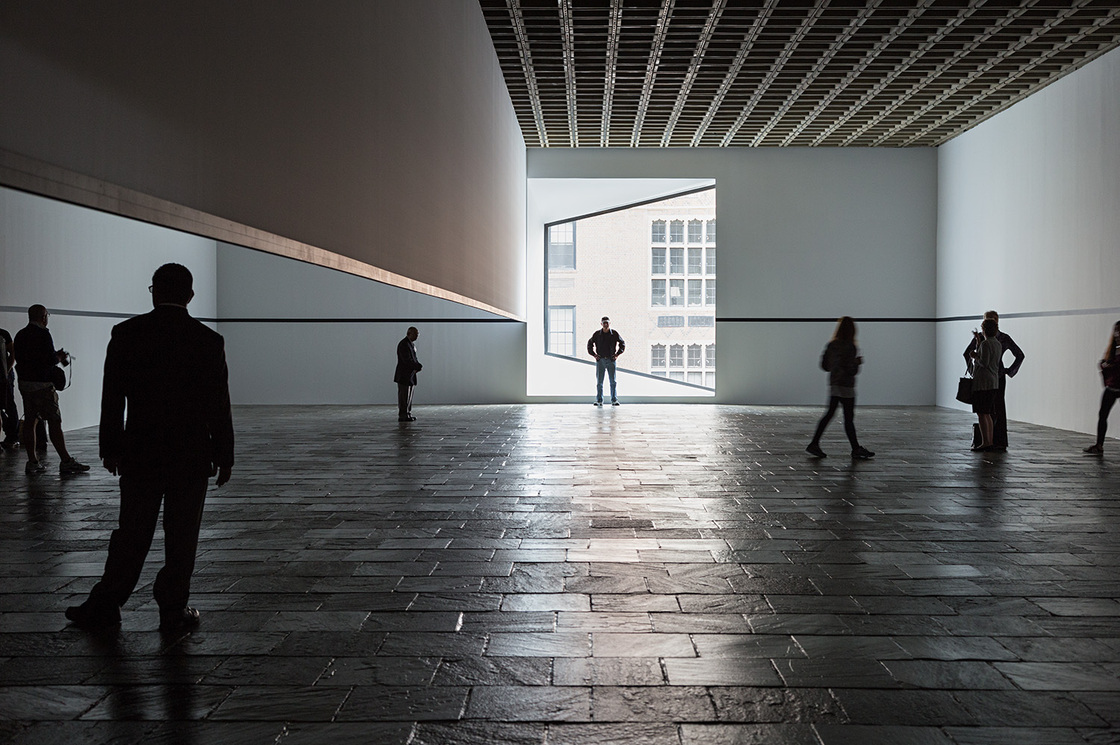 Visitors explore Robert Irwin's Scrim Veil—Black Rectangle—Natural Light during its 2013 reprise at the Whitney Museum of American Art.©Robert Irwin/Photography ©2013 Philipp Scholz Rittermann/Courtesy of the Whitney Museum

 Hide caption In his youth, even before he cavorted with Beau Brummell, the future George IV took liberties in his dress that are particularly evident in this exotic chintz banyan from the 1780s. A quilted and printed loosely cut robe meant for the intimacy of the home environment, the banyan alluded to the mysteries and pleasures of Middle East and Asia. Brighton Royal Pavilion and Museums.
  Hide caption Publications such as the influential fashion journal Gazette du Bon Ton featured illustrations like this one from 1913 by Bernard Boutet de Monvel, which depicts the life of the flaneur, or the fashionable man on the street.
  Hide caption Sartorial Anarchy #5, 2012. Ike Ude, photographer. In his Sartorial Anarchy self-portraits, New Yorkâ??based Nigerian-born artist Ike Ude creates composite images of the dandy across geography and chronology. Ude photographs himself in disparate ensembles, pairing, for example, a copy of an 18th-century Macaroni wig with other carefully selected vintage garments and reproductions. Courtesy of Leila Heller Gallery Ike Ude